
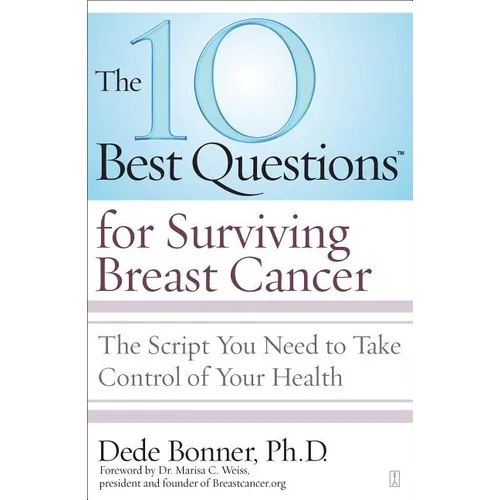
The 10 Best Questions for Surviving Breast Cancer, Dede Bonner
Description
A guide to the questions worth asking after a breast cancer diagnosis, written by Dede Bonner with a foreword by Marisa C. Weiss.
Rather than supplying answers, the book supplies questions, organized in sets of ten and drawn from research and interviews with oncology specialists, physicians, and breast cancer survivors. Alongside the medical questions are ones covering the parts of life a diagnosis affects but appointments rarely address: work and time away from it, what to expect from children, intimacy and relationships, and financial concerns.
It is built to be carried into appointments and used across treatment and recovery.
Paperback, 336 pages, 5.3 by 8.3 inches. Published September 2008.
Medical guidance changes over time. Your care team has the most current information for your situation.
Why It Matters
Having questions written down changes that. You are not relying on memory at the worst possible moment, and you have something to hand to whoever came with you.
The questions nobody prompts you to ask are often the ones that matter most day to day. What this means for work, what to tell your children, what happens to intimacy, what any of it costs. Those rarely come up in an exam room, and they shape the year ahead as much as the treatment plan does.
A guide to the questions worth asking after a breast cancer diagnosis, written by Dede Bonner with a foreword by Marisa C. Weiss.
Rather than supplying answers, the book supplies questions, organized in sets of ten and drawn from research and interviews with oncology specialists, physicians, and breast cancer survivors. Alongside the medical questions are ones covering the parts of life a diagnosis affects but appointments rarely address: work and time away from it, what to expect from children, intimacy and relationships, and financial concerns.
It is built to be carried into appointments and used across treatment and recovery.
Paperback, 336 pages, 5.3 by 8.3 inches. Published September 2008.
Medical guidance changes over time. Your care team has the most current information for your situation.
Blog posts

Easy Foods for Cancer Patients When Nausea Comes and Goes
You might crave toast at 10 a.m., then feel queasy looking at it an hour later. Here are gentle, flexible ways to eat and drink when nausea comes and goes.

Why Am I So Tired After Cancer Treatment? Fatigue and Joint Pain
You finish treatment and expect energy to return. Instead your body feels heavy and your joints ache. Cancer-related fatigue often lingers well beyond the last appointment, and it does not mean you are doing something wrong.
The Power of Small: Micro-Habits That Make Days Easier
During treatment, advice comes from every direction. Here are small habits that fit the day you are actually living, without turning care into a project.


