
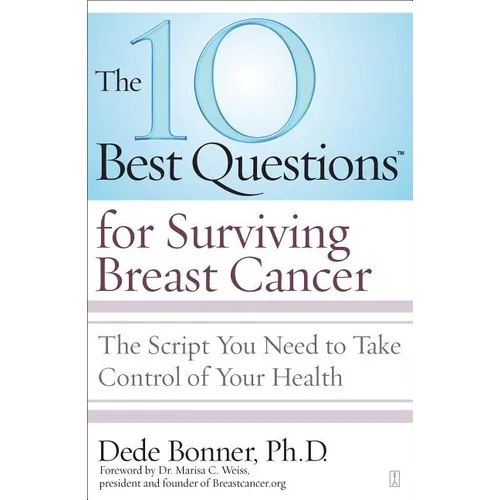
The 10 Best Questions for Surviving Breast Cancer, Dede Bonner
Description
A guide to the questions worth asking after a breast cancer diagnosis, written by Dede Bonner with a foreword by Marisa C. Weiss.
Rather than supplying answers, the book supplies questions, organized in sets of ten and drawn from research and interviews with oncology specialists, physicians, and breast cancer survivors. Alongside the medical questions are ones covering the parts of life a diagnosis affects but appointments rarely address: work and time away from it, what to expect from children, intimacy and relationships, and financial concerns.
It is built to be carried into appointments and used across treatment and recovery.
Paperback, 336 pages, 5.3 by 8.3 inches. Published September 2008.
Medical guidance changes over time. Your care team has the most current information for your situation.
Why It Matters
Having questions written down changes that. You are not relying on memory at the worst possible moment, and you have something to hand to whoever came with you.
The questions nobody prompts you to ask are often the ones that matter most day to day. What this means for work, what to tell your children, what happens to intimacy, what any of it costs. Those rarely come up in an exam room, and they shape the year ahead as much as the treatment plan does.
A guide to the questions worth asking after a breast cancer diagnosis, written by Dede Bonner with a foreword by Marisa C. Weiss.
Rather than supplying answers, the book supplies questions, organized in sets of ten and drawn from research and interviews with oncology specialists, physicians, and breast cancer survivors. Alongside the medical questions are ones covering the parts of life a diagnosis affects but appointments rarely address: work and time away from it, what to expect from children, intimacy and relationships, and financial concerns.
It is built to be carried into appointments and used across treatment and recovery.
Paperback, 336 pages, 5.3 by 8.3 inches. Published September 2008.
Medical guidance changes over time. Your care team has the most current information for your situation.
Blog posts

Intimacy During and After Cancer Treatment
Patients consistently say they want information about sexuality, and consistently report not getting it. Treatment can change desire, comfort, and how you feel in your own body, and the silence around it leaves a lot of people assuming they are the only one.

Living With the What If: Fear After a Cancer Diagnosis
Fear does not end when treatment does. Fear of recurrence is the most commonly reported unmet need in study after study, and almost nobody prepares you for the fact that the worrying gets louder once the appointments stop.

Sleep Problems After Cancer Treatment: Evening Rituals That Help
You can be exhausted all day and still feel wide awake the moment your head touches the pillow. That part can feel especially unfair. Rest does not have to be perfect to count, and winding down still has value on the nights sleep takes its time.


