
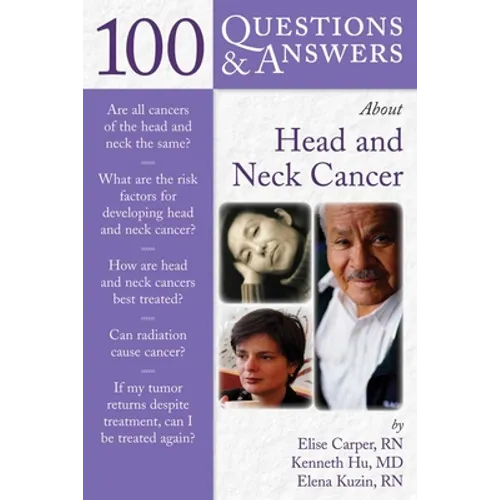
100 Questions and Answers About Head and Neck Cancer, Paperback
Description
A question and answer guide to head and neck cancer, written by Elise Carper, Kenneth S. Hu, and Elena Kuzin, offering both physician and patient perspectives.
The book is organized as 100 questions covering treatment options, quality of life after treatment, and where to find support, for patients and for the people close to them. The format means you can look up a single question without reading the book front to back.
Paperback, 120 pages, 6.49 by 8.94 inches. Published December 2007.
Medical guidance changes over time. Your care team has the most current information for your situation.
Why It Matters
Those are difficult questions to raise. Appointments tend to focus on how treatment is going, and there is rarely a comfortable opening to ask what happens to your voice, or whether food will taste like food again, or what people will notice. So the questions go unasked and get carried home instead.
A reference lets you look those things up privately, in your own time, without saying them out loud to anyone. That alone makes disease specific guides worth having, particularly for cancers where daily life changes in visible ways.
They are also useful to hand to family. The people close to you often want to understand and do not know how to ask either.
A question and answer guide to head and neck cancer, written by Elise Carper, Kenneth S. Hu, and Elena Kuzin, offering both physician and patient perspectives.
The book is organized as 100 questions covering treatment options, quality of life after treatment, and where to find support, for patients and for the people close to them. The format means you can look up a single question without reading the book front to back.
Paperback, 120 pages, 6.49 by 8.94 inches. Published December 2007.
Medical guidance changes over time. Your care team has the most current information for your situation.
Blog posts

Intimacy During and After Cancer Treatment
Patients consistently say they want information about sexuality, and consistently report not getting it. Treatment can change desire, comfort, and how you feel in your own body, and the silence around it leaves a lot of people assuming they are the only one.

Living With the What If: Fear After a Cancer Diagnosis
Fear does not end when treatment does. Fear of recurrence is the most commonly reported unmet need in study after study, and almost nobody prepares you for the fact that the worrying gets louder once the appointments stop.

Sleep Problems After Cancer Treatment: Evening Rituals That Help
You can be exhausted all day and still feel wide awake the moment your head touches the pillow. That part can feel especially unfair. Rest does not have to be perfect to count, and winding down still has value on the nights sleep takes its time.


